
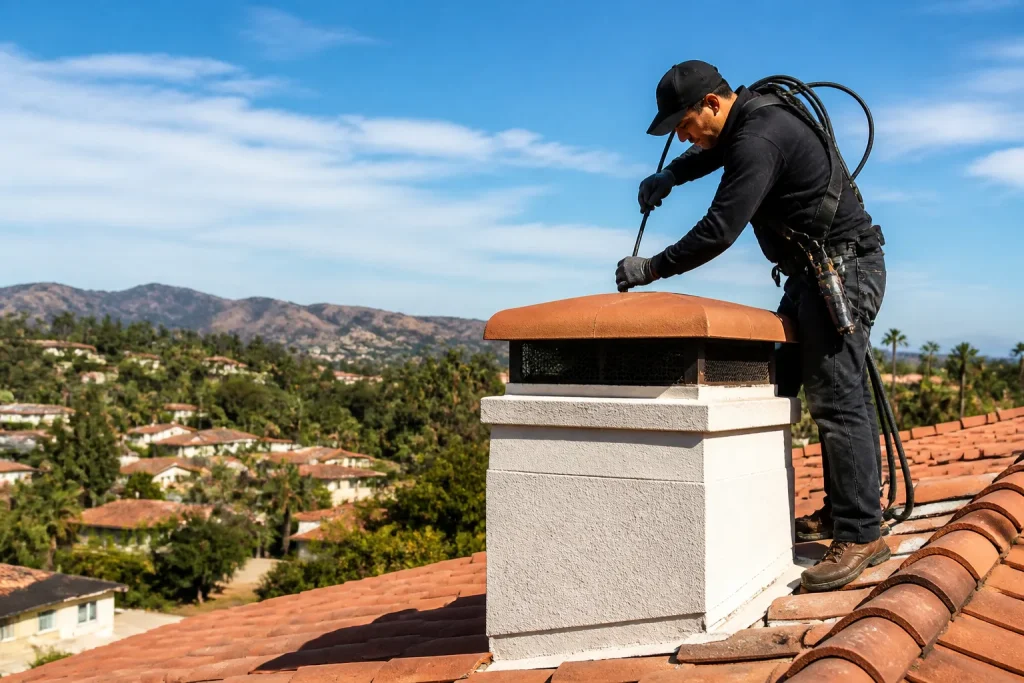
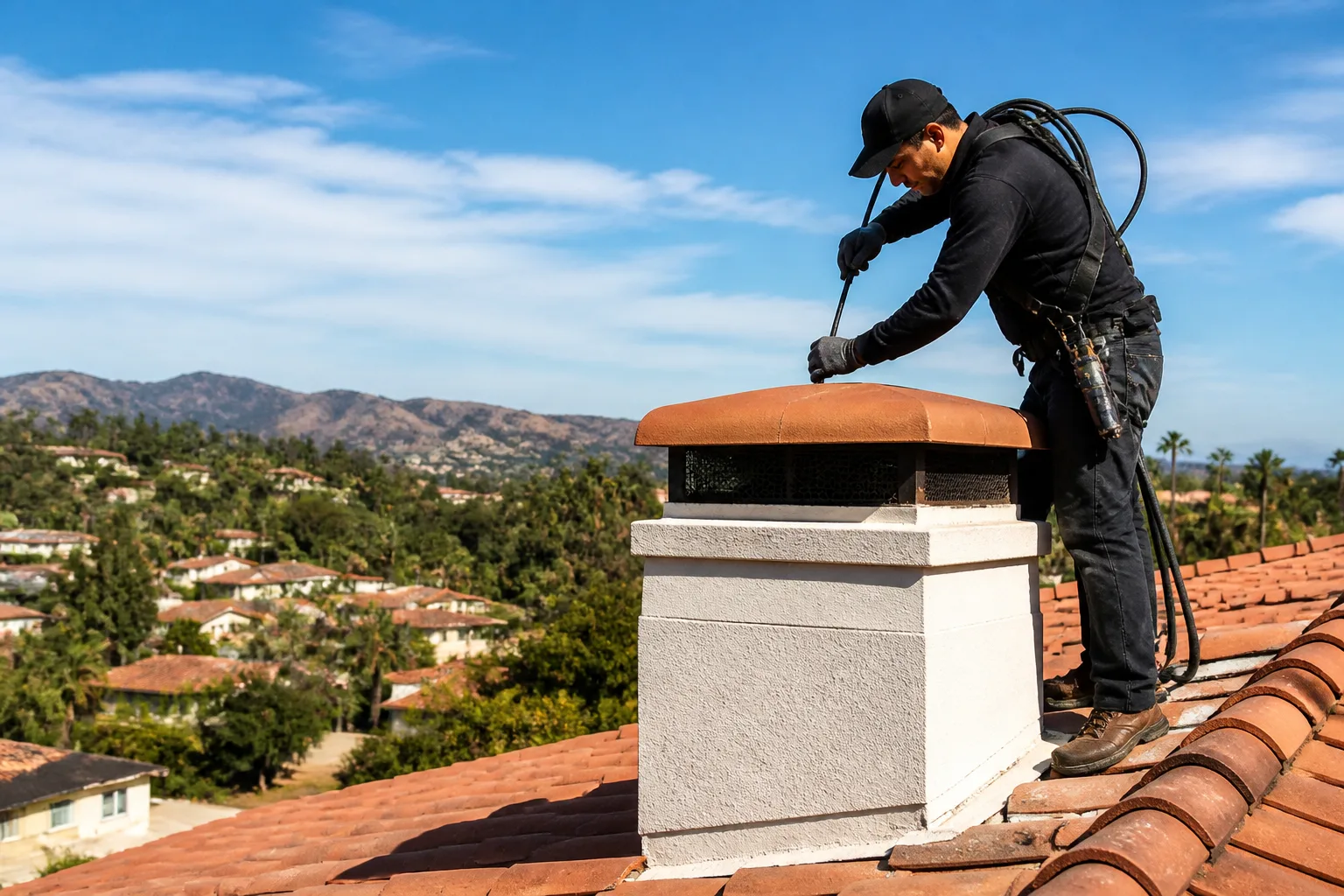
Emergency Chimney Sweep Near Me: What San Juan Capistrano Homeowners Should Do First
A chimney fire can appear to put itself out. The roar stops, the smoke thins, and the flue looks fine from the hearth. But the liner may be cracked in ways that make the next fire a structure fire. Your first 20 minutes after a chimney fire, heavy smoke event, or visible structural damage either limit the damage or make it worse. This is the order to do things in before any contractor arrives.
If you’d rather hand it to a professional, call (844) 451-2583. We answer 24/7. Fast dispatch from 7am to 7pm, Sunday through Friday.
Call 911 or Call a Sweep? The Order That Actually Matters
Call 911 first if there is active fire, flames visible at the top of the chimney, heavy smoke filling the house, or a smell of burning that won’t clear. Firefighters confirm the fire is out and check for extension into the framing. That has to happen before anyone inspects the flue, not after.
Call a sweep first when the fire is clearly out but the chimney may be damaged. Signs that point to a sweep rather than 911:
- You heard a low rumble or roaring, then it stopped
- Creosote flakes or black debris landed on the roof or in the yard
- The damper or firebox shows heat discoloration
- There’s a strong burnt smell with no visible smoke
- You can see cracked or displaced flue tiles from the firebox opening
Why does the order matter? If the fire isn’t fully out, a technician walking in to inspect puts themselves and your house in the path of an active fire. And if 911 responds first, you get a documented report that your insurer will want. We’ve seen homeowners skip that step and struggle later to prove the event. In San Juan Capistrano, where many homes have older masonry chimneys, that documentation is worth capturing.
Has the Chimney Fire Actually Gone Out?
It may not have. Chimney fires can smolder for hours in concealed areas of the chase or in creosote packed against the flue. A chimney that looks calm at the firebox can still have heat trapped in the structure.
What to check from a safe distance:
- Touch the chimney breast on each floor, from the outside wall. If any section is hot to the touch hours after the fire, treat it as active and call 911.
- Look at the cap and crown from the ground. Discoloration, a warped cap, or missing mortar means heat reached the top.
- Smell for creosote and smoke in rooms that share the chimney chase, especially upstairs closets.
- Listen for a low crackling sound when the house is quiet.
If any of those signs are present, the fire may not be out. Do not assume it is because the flames are gone. An Olympia Chimney cap that looks deformed from below is a strong signal the flue got hot enough to damage the liner above it.
What Not to Do After a Smoke or Fire Event
The single most common and most dangerous mistake is to run another fire “to test it.” This is how small damage becomes a house fire. A cracked flue tile, a separated liner seam, or a gap at the thimble lets hot gases and embers reach framing that was never meant to see them. The next fire finds that gap.
Other things to avoid:
- Don’t close the damper on a chimney that may still be hot. Heat needs a path out.
- Don’t hose down the firebox or pour water into the flue. Thermal shock can crack masonry that was intact.
- Don’t run a vacuum or shop vac in a firebox with creosote dust still settling. It can ignite.
- Don’t have anyone “take a quick look” without a camera. You need to know the liner condition, not just that the firebox looks fine.
In our experience, the homeowners who avoid the second fire are the ones who get the clearest answer first. It costs far less to confirm a liner is intact than to repair a fire-damaged chase.
What to Document Before Anyone Enters the Chimney
Your insurance claim, safety record, and repair decisions all depend on what you capture in the first hour. Take photos and timestamps before anyone touches the fireplace.
- Photos of the firebox, damper, hearth, and the full face of the chimney inside and out
- Close-ups of any creosote, soot staining, cracked tile, or displaced mortar
- Photos of the roof and cap if you can safely see them from the ground
- Notes on the appliance settings at the time of the event: damper position, air control, type of wood or gas appliance, and any insert or stove brand
- Timestamps of when you noticed the event and when it appeared to stop
- A list of who responded if 911 attended, including the report number if you can get it
This is not busywork. A legitimate inspection starts by asking what happened and when. Without that record, a technician is looking at a chimney with no history. In San Juan Capistrano, where older homes may have had several fireplaces altered over the years, that history matters.
What a Real Emergency Inspection Covers
A rushed inspection checks a box and leaves you with no real answers. A legitimate one tells you whether the chimney is safe to use as-is, needs repair, or needs a full reline. Here is the difference.
A real inspection covers:
- A video camera scan of the full flue length, from firebox to cap
- A look at the firebox, damper, smoke chamber, and thimble
- Assessment of the cap and crown for heat damage or displacement
- A check for creosote depth and type that may need to be swept before judging the liner
- Photos you can see, with a written summary of what was found and what should be done
A rushed visit tends to skip:
- The camera scan, relying instead on a flashlight from the firebox opening
- The chase and concealed areas
- Written documentation
If the flue is compromised but not failed, HeatShield ceramic resurfacing can restore integrity without a full reline; if the liner needs replacing, we install DuraFlex flexible stainless liners rated for wood, gas, and oil. We name our brands because they matter to your safety. Our technicians have up to 11 years of experience, and the same team that inspects the chimney can handle the chimney repair rather than handing you off to a second contractor.
When to Call a Pro
Call us after 911 confirms the fire is out, or instead of 911 if there is no active fire and the symptoms point to damage. Also call if you’ve found creosote buildup, a cracked flue visible from the firebox, or a cap or crown that has clearly taken heat. A chimney sweep should come with a camera and a written report, not just a brush and a nod.
Related services in San Juan Capistrano
After a chimney event, we handle fireplace repair for everything from damper damage to firebox mortar, and full Chimney Sweep San Juan Capistrano services for cleaning, inspection, cap and crown work, and structural repair. One specialist from the first sweep to the last repair.
How Much Does Emergency Chimney Service Cost in San Juan Capistrano?
Estimates are free, and pricing is set per job by the written estimate. Typical cost depends on what the inspection finds, not how fast you need it. The estimate covers the work, the materials, and any repair options, so you can decide what happens next without pressure.
What you should expect in a written estimate:
- A line for inspection, including the camera scan and photo report
- A line for sweeping if creosote needs removal before the liner can be judged
- Any needed cap, crown, chimney sweep service, or repair broken out individually
- Repair options in plain language, with what can wait and what can’t
Nothing is recommended without camera evidence you can see for yourself. If a repair can safely wait, we’ll say so. Call (844) 451-2583 for an exact quote. Estimates are free.
The Bottom Line
A chimney fire is not over when the flames are. The liner is the part that decides whether the next fire is safe. Your order of operations is: 911 if there is active fire or heavy smoke; a sweep if the fire is out but the chimney may be damaged; document everything before anyone enters; do not test with another fire.
If you’re in San Juan Capistrano and need help, Chimney Sweep San Juan Capistrano offers free estimates. Call (844) 451-2583. We answer 24/7. Fast dispatch from 7am to 7pm, Sunday through Friday. We use HeatShield for flue resurfacing, Gelco and Famco components for cap and crown work, and we can handle the full lifecycle of your chimney from the first sweep to structural repair.
Frequently Asked Questions
Estimates are free and pricing is set per job by the written estimate, so there is no single number until the chimney’s condition is known. A standard sweep costs less than a sweep combined with a camera inspection, and repair work is quoted separately. Call (844) 451-2583 for an exact quote. Estimates are free.
No, not always. A liner may be reusable if the camera scan shows it intact. If the flue is compromised but not failed, HeatShield ceramic resurfacing can restore integrity without a full reline. A new DuraFlex liner is recommended only when the camera shows damage that resurfacing can’t address. Nothing is recommended without camera evidence you can see.
A chimney used regularly for wood should be checked before each heating season, and swept when creosote buildup reaches a level that warrants it. A long dormant fireplace or a new home purchase should be inspected before the first fire. Call (844) 451-2583 to book a sweep or inspection. Estimates are free.
The next fire runs through whatever the camera would have found. A small crack, a separated seam, or a displaced tile lets heat and embers reach framing. That’s the path from a small repair to a house fire. It’s not worth the risk. Call (844) 451-2583. We answer 24/7. A call outside dispatch hours is booked into the next opening, Sunday through Friday, 7am to 7pm.
Written by the team at Chimney Sweep San Juan Capistrano.
Need Chimney Cleaning Help?
Call Chimney Sweep San Juan Capistrano - the local pro we connect you with is licensed and insured, here with fast help in San Juan Capistrano.
(844) 451-2583